| 查看上一个主题 :: 查看下一个主题 |
| 作者 |
内容 |
IANUS 

注册时间: 2008年10月14日
文章: 276
来自: Germany
|
 发表于: 周五 6月 25, 2010 7:32 am 文章标题: Light metering with bellows - How to? |
|
发表于: 周五 6月 25, 2010 7:32 am 文章标题: Light metering with bellows - How to? |
|
|
IANUS wrote:
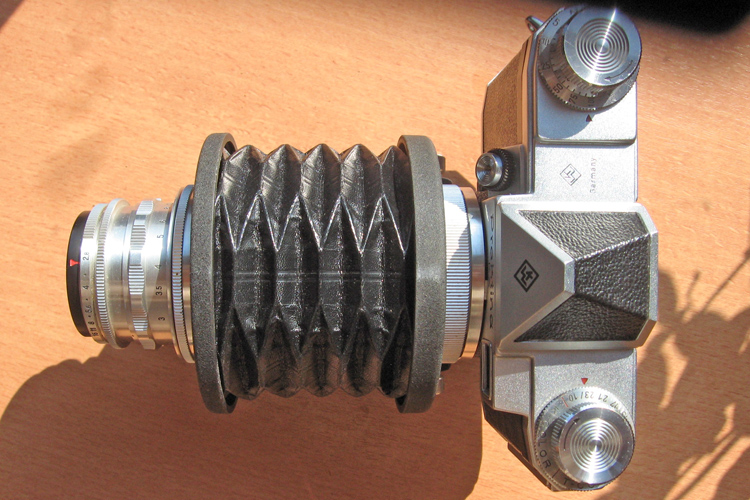
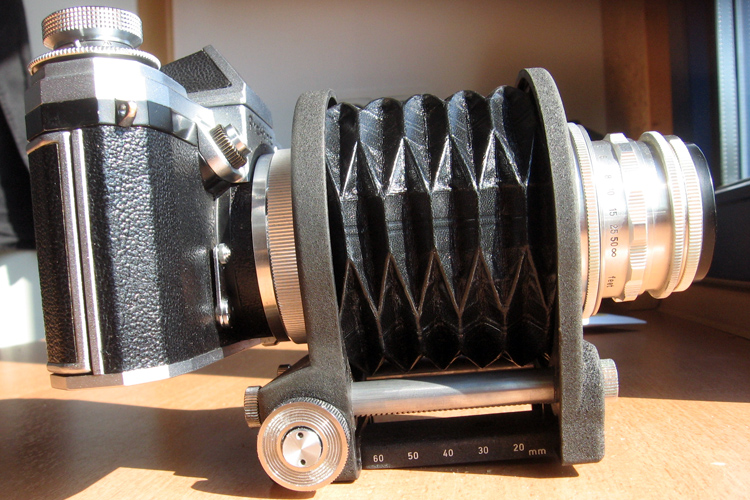
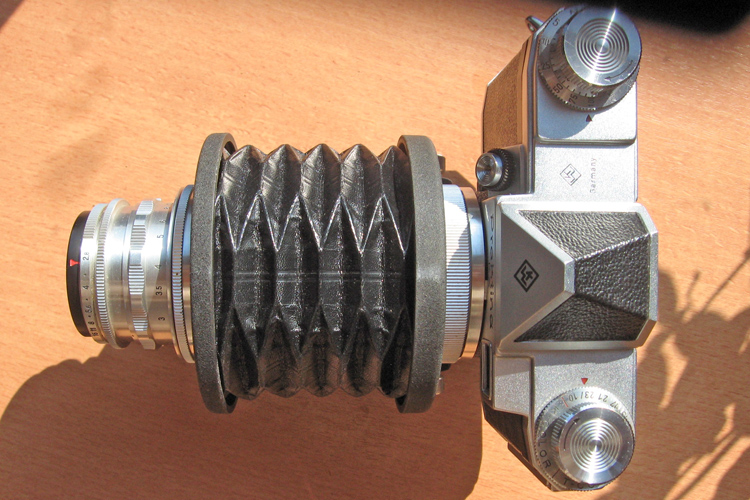
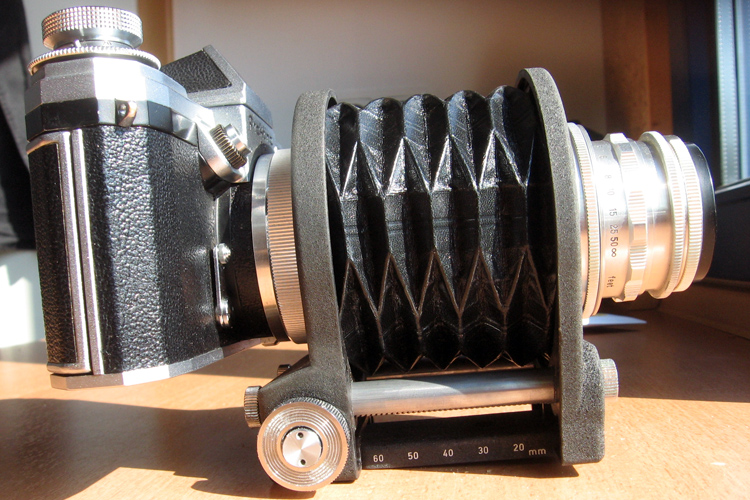
I've got a bellows unit for a Praktina camera and want to test it. Unfortunately I don't have a description for it and so I am questioning how I have to do the light metering. I never used a bellows for makro shots, only extension rings where I had to use factors for longer exposure. Obviously there is no ttl metering, which would be much easier.
Can anyone give me a description how to use the light meter with this set. I do hav a Gossen Profisix meter where I can dial in the factors for longer exposures but I have to somehow calculate them for myself.
Another question would be using a (manual) flash. How do I set up the flash.
 |
|
| 返回顶部 |
|
 |
Excalibur


注册时间: 2009年7月19日
文章: 5018
来自: UK
Expire: 2014-04-21
|
发表于: 周五 6月 25, 2010 7:42 am 文章标题: |
|
发表于: 周五 6月 25, 2010 7:42 am 文章标题: |
|
|
Excalibur wrote:
As a film user this would be the time I wished for a DSLR, and I would think with that camera you would have to bracket your shots for exposure.
_________________
Canon A1, AV1, T70 & T90, EOS 300 and EOS300v, Chinon CE and CP-7M. Contax 139, Fuji STX-2, Konica Autoreflex TC, FS-1, FT-1, Minolta X-700, X-300, XD-11, SRT101b, Nikon EM, FM, F4, F90X, Olympus OM2, Pentax S3, Spotmatic, Pentax ME super, Praktica TL 5B, & BC1, , Ricoh KR10super, Yashica T5D, Bronica Etrs, Mamiya RB67 pro AND drum roll:- a Sony Nex 3
.........past gear Tele Rolleiflex and Rollei SL66.
Many lenses from good to excellent. |
|
| 返回顶部 |
|
|
IANUS
注册时间: 2008年10月14日
文章: 276
来自: Germany
|
发表于: 周五 6月 25, 2010 7:46 am 文章标题: |
|
发表于: 周五 6月 25, 2010 7:46 am 文章标题: |
|
|
IANUS wrote:
| 引用: |
As a film user this would be the time I wished for a DSLR, and I would think with that camera you would have to bracket your shots for exposure.
|
I know a DSLR would make most things easier but I may have to wait another 20-30 years to get a "classic" DSLR to play with  .
As a amateur-shooter I can allow me a whole film with bad shots and noone complains.
Bracketing is a good idea but this doesn't solve the problem from which center I am bracketing. |
|
| 返回顶部 |
|
|
alex

注册时间: 2009年4月18日
文章: 561
来自: UK
|
发表于: 周五 6月 25, 2010 9:17 am 文章标题: |
|
发表于: 周五 6月 25, 2010 9:17 am 文章标题: |
|
|
alex wrote:
If you can use a scientific calculator, a very rough measure of the exposure compensation can be calculated this way :
Measure the extension of the bellows from the camera lens mount to where the bellows meet the lens.
Calculate log10 ( (extension + lens focal length) / lens focal length )
Divide result by 0.3. [This is to convert a log10 calculation to a log2 calculation in case your calculator doesn't have a log2 key.]
That's the exposure compensation in stops.
Example : bellows extension 30mm, lens focal length 50mm
log10 ( 80 / 50 ) = 0.204
0.204 / 0.3 = 0.68 or 2/3rds of a stop.
There are other factors that come in to play, such as the focus distance, because this calculation assumed the lens is focussed at infinity, but it's a starting point. You could probably draw up a little table for different bellows extension lengths and attached lens focal lengths.
_________________
Alex |
|
| 返回顶部 |
|
|
IANUS
注册时间: 2008年10月14日
文章: 276
来自: Germany
|
发表于: 周五 6月 25, 2010 12:33 pm 文章标题: |
|
发表于: 周五 6月 25, 2010 12:33 pm 文章标题: |
|
|
IANUS wrote:
thanks alex, I will try this. |
|
| 返回顶部 |
|
|
Farside

注册时间: 2007年9月1日
文章: 6579
来自: Ireland
Expire: 2013-12-27
|
发表于: 周六 6月 26, 2010 12:02 am 文章标题: |
|
发表于: 周六 6月 26, 2010 12:02 am 文章标题: |
|
|
Farside wrote:
Rough rule of thumb based on the inverse square law: if the lens is twice the distance from the film than it is normally, you get a quarter of the light intensity on the film, so you'd have to open up two stops or two shutter speeds.
Extrapolate from there, using your bellows distance as it actually is, when you're set up on the subject, compared to normal lens to film plane distance.
This gives you a starting point, but the relationship might not be utterly reliable as you go out further - trial and error to a certain extent thereafter.
Here's a useful device http://www.salzgeber.at/disc/
_________________
Dave - Moderator
Camera Fiend and Biograph Operator
If I wanted soot and whitewash I'd be a chimney sweep and house painter.
The Lenses of Farside (click)
BUY FRESH FOMAPAN TO HELP KEEP THE FACTORY ALIVE ---
Foma Campaign topic -
http://forum.mflenses.com/foma-campaign-t55443.html
FOMAPAN on forum -
http://www.mflenses.com/fs.php?sw=Fomapan
Webshop Norway
http://www.fomafoto.com/
Webshop Czech
https://fomaobchod.cz/inshop/scripts/shop.aspx?action=DoChangeLanguage&LangID=4 |
|
| 返回顶部 |
|
|
RioRico

注册时间: 2010年3月12日
文章: 1120
来自: California or Guatemala or somewhere
|
发表于: 周六 12月 11, 2010 5:10 pm 文章标题: |
|
发表于: 周六 12月 11, 2010 5:10 pm 文章标题: |
|
|
RioRico wrote:
Another way to calculate this, starting with magnification:
MAG = (TE-FL) / FL where TE is total extension and FL is focal length
So with a 50mm camera lens on 100mm of extension, TE= 150mm. Magnification is (150-50)/50 or 2X. Now we can calculate f-stops:
EA = NA * (MAG+1) where EA is effective aperture and NA is nominal aperture
So with the previous setup and the lens set to f/11 (the nominal aperture), the effective aperture is 11 * (2+1) or f/33. You need to adjust exposure by 3 f-stops. More simply, exposure adjustment is (MAG+1) f-stops.
_________________
Too many film+digi cams+lenses, oh my -- Pentax K20D, K-1000, M42s, more
The simple truth is this: There are no neutral photographs. --F-Stop Fitzgerald |
|
| 返回顶部 |
|
|
|
|
|
您不能在本版块发表新主题
您不能回复本版块的主题
您不能编辑自己在版块内的文章
您不能删除自己在版块内的文章
您不能参与本版块的投票
|
 中文
 Español
 Magyar
 Русский
 Deutsch
 日本語
 Français