| 查看上一个主题 :: 查看下一个主题 |
| 作者 |
内容 |
connloyalist 

注册时间: 2020年7月22日
文章: 381
来自: the Netherlands
|
 发表于: 周四 3月 16, 2023 5:53 pm 文章标题: Olympus Pen-F 250mm f5 |
|
发表于: 周四 3月 16, 2023 5:53 pm 文章标题: Olympus Pen-F 250mm f5 |
|
|
connloyalist wrote:
I am looking at an Olympus Pen-F 250mm f/5 on eBay. This is a half frame lens (for which I do have an adapter). It is my understanding that the 250mm is not very common. It is also somewhat heavy at 800 grams.
Anybody have any experience with this one? I own two PEN-F lenses and they are very nice, except a bit questionable on the radioactivity side of things (both make the meter beep but read normal after a full measuring cycle; weird). I have read that quite a few of these PEN lenses have some degree of radioactivity.
Anyway, curious if anyone has an opinion on the optical characteristics of this 250mm.
Regards, C. |
|
| 返回顶部 |
|
 |
eggplant


注册时间: 2020年5月27日
文章: 517
|
发表于: 周四 3月 16, 2023 8:22 pm 文章标题: |
|
发表于: 周四 3月 16, 2023 8:22 pm 文章标题: |
|
|
eggplant wrote:
Well, the (new to me - why didn't I look here sooner?) diagram from the Ponder and Best information booklet certainly is interesting - has to be another dense-flint 'apochromat'. For I don't know any other reason for the front group to look like that.
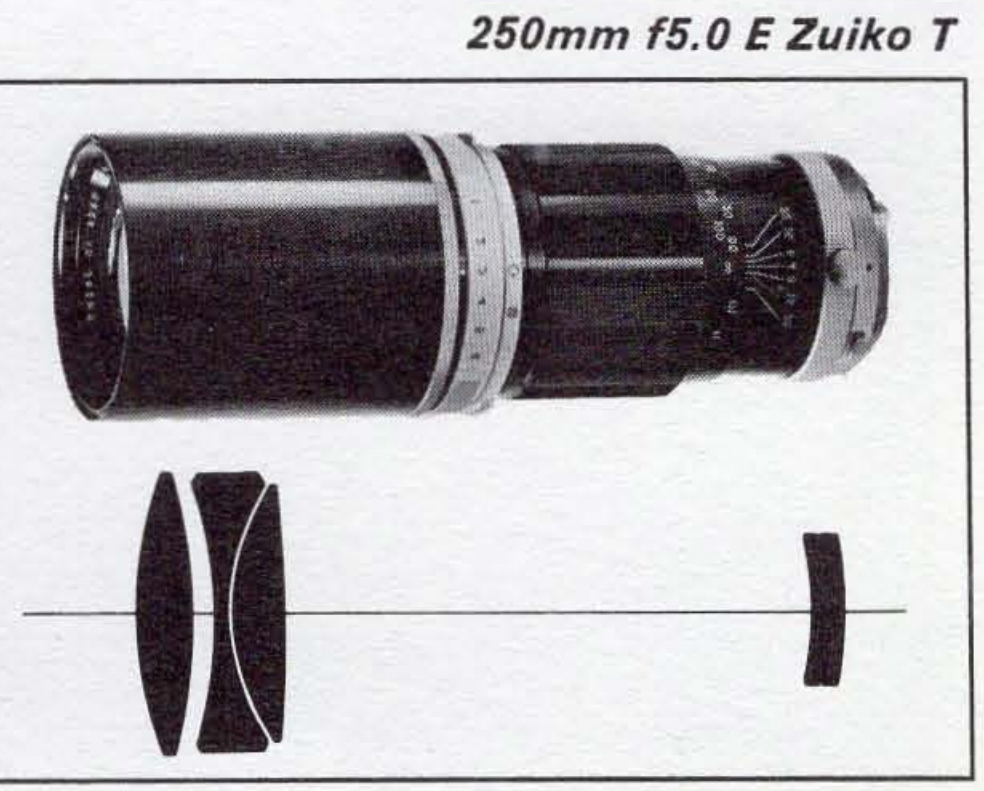
1.42x crop factor would make it 355mm (f7.1) equivalent.
_________________
UK |
|
| 返回顶部 |
|
|
connloyalist
注册时间: 2020年7月22日
文章: 381
来自: the Netherlands
|
发表于: 周四 3月 16, 2023 10:07 pm 文章标题: |
|
发表于: 周四 3月 16, 2023 10:07 pm 文章标题: |
|
|
connloyalist wrote:
I am sorry, "dense flint apochromat".... can you please explain?
Regards, C. |
|
| 返回顶部 |
|
|
iangreenhalgh1


注册时间: 2011年3月18日
文章: 15679
Expire: 2014-01-07
|
发表于: 周四 3月 16, 2023 11:44 pm 文章标题: |
|
发表于: 周四 3月 16, 2023 11:44 pm 文章标题: |
|
|
iangreenhalgh1 wrote:
The Pen F lenses are indeed excellent, but I doubt the 250mm was an apochromatic lens, it's too old to have made much use of Thorium, Lanthanum etc.
_________________
I don't care who designed it, who made it or what country it comes from - I just enjoy using it! |
|
| 返回顶部 |
|
|
eggplant
注册时间: 2020年5月27日
文章: 517
|
发表于: 周五 3月 17, 2023 12:07 am 文章标题: |
|
发表于: 周五 3月 17, 2023 12:07 am 文章标题: |
|
|
eggplant wrote:
| connloyalist 写道: |
I am sorry, "dense flint apochromat".... can you please explain?
Regards, C. |
Sorry - I should remember that's not quite common knowledge yet.. 
It is a type of optical design found in long (300mm+) focal length lenses that's quite distinct in it's deeply curved front triplet. This is used to apochromatically correct CA without notably low dispersion glass.
It is still recognizable even allowing for design variations.
I would like to say there is more to it, but there are only a few considerations and a few elements here (with the rear two serving to flatten the field). Once you put chromatic aberration to one side or settle for an average amount of it, we know what design can be used to achieve this speed - a simple doublet up front with a 1-2 element rear field flattener, or even a 4 element ernostar, all with less extreme curvature. As we have seen countless times before.
It is only CA that is this problematic to avoid at this aperture + focal length, often noted as requiring special treatment from growing in proportion to focal length. Which is hard to say about other aberrations.
For explanation (and discussion after this post of other lenses that count) see here
_________________
UK |
|
| 返回顶部 |
|
|
iangreenhalgh1
注册时间: 2011年3月18日
文章: 15679
Expire: 2014-01-07
|
发表于: 周五 3月 17, 2023 12:17 am 文章标题: |
|
发表于: 周五 3月 17, 2023 12:17 am 文章标题: |
|
|
iangreenhalgh1 wrote:
I know that the most commonluy seen design for an apochromatic lens back in the 50s-60s was the dialyte - 4 air spaced elements. Most apo process lenses from this period are dialiytes, the rest are tessars, they were superceded by plasmats mostly. No exotic glasses involed, but the maximum apertures were of the order f9, f10, f11.
_________________
I don't care who designed it, who made it or what country it comes from - I just enjoy using it! |
|
| 返回顶部 |
|
|
connloyalist
注册时间: 2020年7月22日
文章: 381
来自: the Netherlands
|
发表于: 周五 3月 17, 2023 7:10 am 文章标题: |
|
发表于: 周五 3月 17, 2023 7:10 am 文章标题: |
|
|
connloyalist wrote:
| eggplant 写道: |
| connloyalist 写道: |
I am sorry, "dense flint apochromat".... can you please explain?
Regards, C. |
Sorry - I should remember that's not quite common knowledge yet..
It is a type of optical design found in long (300mm+) focal length lenses that's quite distinct in it's deeply curved front triplet. This is used to apochromatically correct CA without notably low dispersion glass.
It is still recognizable even allowing for design variations.
I would like to say there is more to it, but there are only a few considerations and a few elements here (with the rear two serving to flatten the field). Once you put chromatic aberration to one side or settle for an average amount of it, we know what design can be used to achieve this speed - a simple doublet up front with a 1-2 element rear field flattener, or even a 4 element ernostar, all with less extreme curvature. As we have seen countless times before.
It is only CA that is this problematic to avoid at this aperture + focal length, often noted as requiring special treatment from growing in proportion to focal length. Which is hard to say about other aberrations.
For explanation (and discussion after this post of other lenses that count) see here |
Aha, thank you. Interesting. It seems to me that in the 1960's when these PEN-F lenses were made Olympus may have had the technology available to make these cost effectively? Would the fact that this is a half-frame lens make the manufacturing process easier?
Regards, C. |
|
| 返回顶部 |
|
|
|
|
|
您不能在本版块发表新主题
您不能回复本版块的主题
您不能编辑自己在版块内的文章
您不能删除自己在版块内的文章
您不能参与本版块的投票
|
 中文
 Español
 Magyar
 Русский
 Deutsch
 日本語
 Français


